Since the start of the full-scale war, electricity in Ukraine has become more than a household or operating issue. It is directly tied to safety, continuity and the ability to plan even the next day.
After 2022, autonomy became a new kind of value
Damage to energy infrastructure, blackouts, overloaded grids and the risk of new attacks changed the way people see alternative energy. A solar power system is no longer viewed only as a way to save money or earn from feed-in tariffs, but increasingly as a tool for autonomy.
For households, that means light, internet, heating, water and core appliances even when the grid is unstable. For businesses, it means continuity: energy became part of operating resilience, not just a utility bill.
Why demand for self-generation keeps growing
Ukraine’s energy system was built around large generation facilities. In wartime, that model proved vulnerable: when major plants, substations or high-level grid connections are hit, entire regions feel the impact.
That is why distributed generation is becoming more important - smaller and mid-scale power sources located closer to the end user. They do not replace the centralized system completely, but they give households and companies more control over their own consumption.
- Rooftop solar for private homes
- Solar stations for businesses and commercial sites
- Local energy solutions for communities
- Hybrid systems with battery storage
- Resilience-oriented systems for critical loads
Hybrid systems and batteries are becoming the new baseline
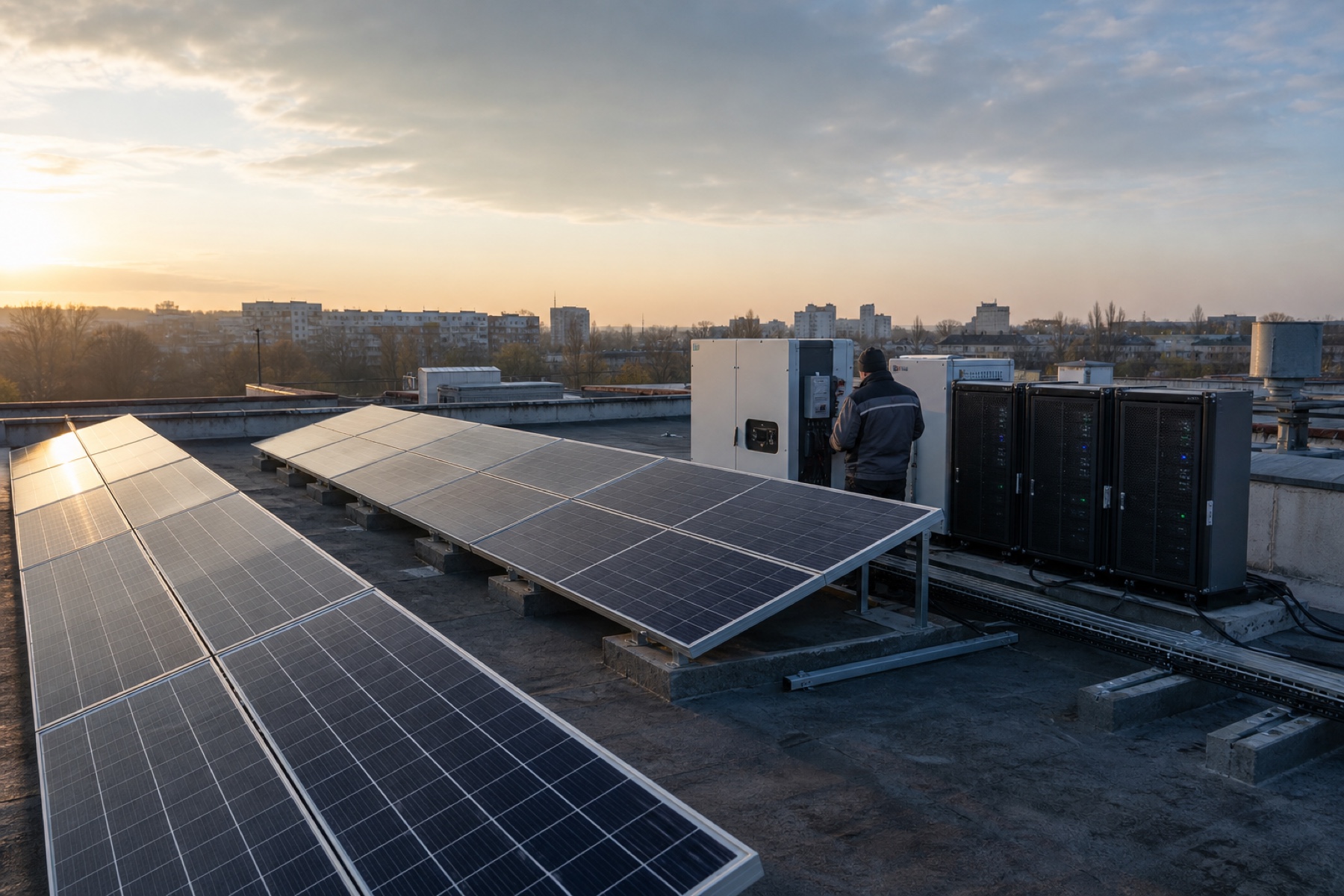
Demand is shifting from “just panels” to full systems: panels, inverter, batteries, automation, monitoring and service. A classic grid-tied station is good for savings, but it does not always solve the autonomy problem during outages.
That is why customers now ask more often about hybrid solutions. For households, it is about maintaining basic comfort. For businesses, it is about keeping equipment, cash desks, refrigerators, servers, lighting and other non-stop processes running.
Businesses are not buying panels. They are buying stability.
The B2B segment is now one of the strongest growth areas in solar energy. The reason is simple: businesses calculate not only the cost of electricity, but also the cost of losing it.
For manufacturing, that means stopped lines. For warehouses, product and logistics risks. For hotels, unhappy guests. For retail, problems with checkout, refrigeration and lighting. For medical facilities, risks to equipment and patient service.
- Manufacturing
- Agribusiness
- Warehouses and logistics sites
- Retail locations
- Fuel stations, service stations and car washes
- Hotels and leisure sites
- Medical facilities
- Municipal enterprises
Private customers need simple communication
Household demand is also growing, but the product is often too complex for the buyer. Most people do not want to decode the technical difference between grid-tied and hybrid stations, why a battery is needed, how an inverter works, what net billing means and how much savings are realistic.
Because of that, some customers delay the decision or compare only price. That is risky for the market: the cheapest offer is not always the right system for a specific house and usage profile.
Payback, trust and post-installation service still matter
Even when a customer buys solar because of blackout risk, they still want to understand the economics. Households care about total system cost, payback period, expected savings, warranties and equipment lifespan. Businesses care even more about monthly savings, investment return and which outage losses can be reduced.
A strong commercial proposal must explain the logic, not only list components. And the story does not end at installation: warranty, diagnostics, future scaling, battery expansion and fast service response are now part of the product.
The public sector and segmentation both matter
There is also strong potential in state and municipal facilities: hospitals, schools, universities, water utilities, heating providers, military sites and other critical infrastructure. For them, solar with battery systems is becoming part of energy resilience, not only a way to save money.
Another key shift is the need for real segmentation. Not every customer buys for the same reason: some buy savings, others autonomy, others operational continuity, and public institutions buy resilience. Marketing and sales need to reflect that motivation instead of using the same message for everyone.
Summary
The solar energy market in Ukraine is changing quickly. Demand is now shaped not only by savings, but by the need for energy independence, continuity and protection from outages.
The biggest opportunity lies in hybrid systems, battery-backed solutions, B2B projects, critical infrastructure and customers with high consumption. The winners are companies that can show practical value: how the solution saves money, how it performs during outages, what risks it reduces and who supports the customer after installation.